Signature Issue

A Slope Ordinance With Teeth

For over fifty years, the penalty for destroying a protected hillside in Alabama has been stuck in the past. John wrote the bill that fixes it — here's the what, the why, and the how.

The Problem

Our Mountains Are Protected on Paper Only

Huntsville's Slope Development District regulations (Article 65 of the zoning ordinance) restrict clearing and grading on our steepest terrain — Green Mountain, Monte Sano, and the ridgelines that make southeast Huntsville worth living in. The rules exist because the science is unforgiving: these slopes sit on colluvium, a loose layer of soil and rock that stays put only because mature root systems anchor it.

When those trees come down, the slope lets go. Stormwater that the canopy used to absorb tears downhill instead — washing out trails, flooding the homes below, and cracking the roads that taxpayers then rebuild.

Yet developers have clear-cut protected "do not disturb" zones anyway, betting that a premium bluff view is worth more than any penalty the city can impose. On the numbers, they're right. That's the problem.

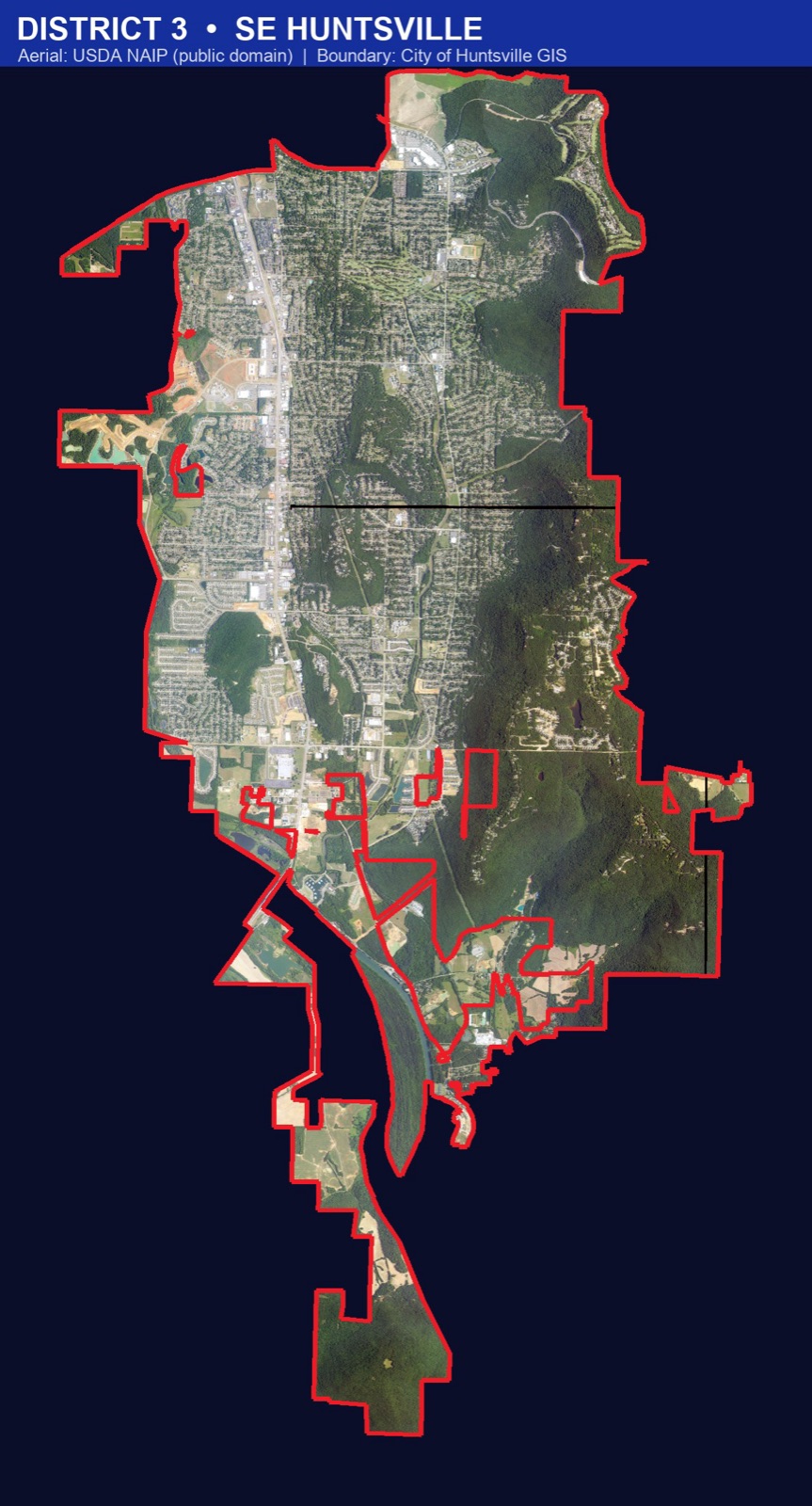
Aerial of southeast Huntsville showing Green Mountain rising over District 3 neighborhoods
The Broken Law

$500. Unchanged Since 1975.

Alabama Code § 11-45-9 caps the fine a city can charge for an ordinance violation at $500. That number was set in 1975 — when $500 actually meant something. Adjusted for inflation it would be roughly $3,000 today. The legislature has updated the cap for other offenses — DUI now carries up to $5,000, third-degree theft up to $1,000 — but the penalty for destabilizing a mountainside never moved.

1975the year the $500 cap was set
$5,000today's cap for a DUI — raised by the state
$500still the cap for clear-cutting a protected slope

Huntsville's only workaround is to "stack" citations — each day as a separate offense, each tree as a separate violation. The per-day rule stands on solid legal ground. The per-tree multiplier is being fought in court right now, and if it falls, every city in Alabama loses its best leverage against the worst actors. We shouldn't be running our environmental enforcement on a legal workaround and crossed fingers.

The Fix

John Wrote the Bill

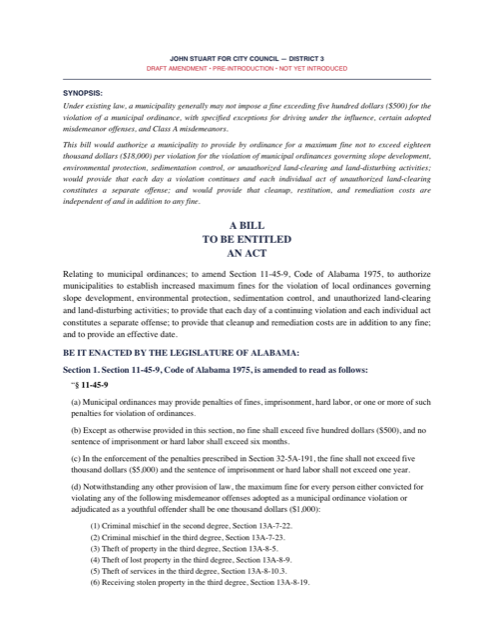
Not a petition. Not a strongly worded letter. A drafted amendment to state law, ready for a sponsor in the Madison County legislative delegation.

What the bill does

  • Amends Alabama Code § 11-45-9 to let municipalities set fines up to $18,000 per violation, per day for ordinances governing slope development, environmental protection, sedimentation control, and unauthorized land-clearing
  • Writes the rule into statute that each day a violation continues is a separate and distinct offense — no more relying on courtroom interpretation
  • Makes each unpermitted removal of a protected tree citable as a separate occurrence
  • Keeps clean-up, restitution, and slope-restoration costs independent of and in addition to any fines — violators restore the hillside no matter what

Why $18,000?

It isn't a number pulled from the air. The original $500 fine, adjusted for inflation, is about $3,000. The state applied roughly a six-fold increase when it modernized other penalties. Apply that same factor — 6 × $3,000 — and you get $18,000: the 1975 penalty, restored to its original seriousness, scaled the way the legislature itself has scaled comparable fines.

How it becomes law

  1. Find the sponsor

    Only a sitting legislator can introduce a bill — in either chamber. John is pitching the draft to the Madison County delegation, starting with Rep. James Lomax (House District 20 — South Huntsville, Monte Sano, and Hampton Cove) and Sen. Sam Givhan (Senate District 7, chairman of the Madison County Local Legislation Committee).

  2. Legislative Services review

    State attorneys format the draft into a formal bill and attach a fiscal note.

  3. Committee

    The bill is heard in committee — where development lobbies will push back, and where public support from Huntsville matters most.

  4. Both chambers

    Identical text must pass the House and Senate.

  5. Governor's signature

    Signed into law, the new cap becomes available to every municipality in Alabama — not just Huntsville.

While our state has rightly acted to increase penalties for major offenses like DUI, our local protections for our hillsides and green spaces have been left without the teeth needed to deter bad actors. This isn't just about fines — it's about holding developers accountable and preserving the character of Huntsville for generations to come.
— John Stuart

Fair Questions, Straight Answers

"Isn't this anti-growth?"

No. Builders who follow the rules — the overwhelming majority — are unaffected and frankly protected, because they stop competing against operators who cheat. The bill targets one thing: knowingly destroying protected slopes.

"Why state law and not city hall?"

Because Alabama cities only have the powers the state grants them. The fine cap lives in the Code of Alabama, so the fix has to happen in Montgomery. A council member who understands that — and shows up with a drafted bill — gets it done faster than one who writes resolutions.

"Is a big fine really a deterrent?"

Neighboring states say yes. Georgia's erosion-control law already makes each day a separate violation at up to $2,500 per day. At $500 flat, breaking the rules is cheaper than following them; at $18,000 per day, it never is.

Who pays when the slope fails?

You do. When an illegally cleared hillside gives way, the public pays to repair washed-out roads and overloaded storm drains, and stranded homebuyers pay lawyers to chase refunds on lots they can't build on. A real penalty structure moves that cost back where it belongs — onto the people who caused the damage.

Help Give It Teeth

A bill needs a sponsor, and a sponsor needs to see that Huntsville is behind it. Add your name, share the plan, and let's get this to Montgomery. Fixing what's broken — that's what believing in better looks like.

Join the Effort Ask John About It