Yes—the pedestrian “Skybridge” is part of PARC, but it is not the whole project. PARC stands for Pedestrian Access and Redevelopment Corridor. It combines a bridge over Governors Drive and Memorial Parkway with Pinhook Creek flood work, stream restoration, a linear park, greenway, three smaller pedestrian bridges, and replacement of an aging railroad bridge.
Construction began with the creek work in 2026. The large bridge remains a later phase.
$47.34 milliontwo federal grant awards
$20.09 millionfirst construction contract
1.2 mileslinear park in the current federal scope
6,000 feetplanned greenway
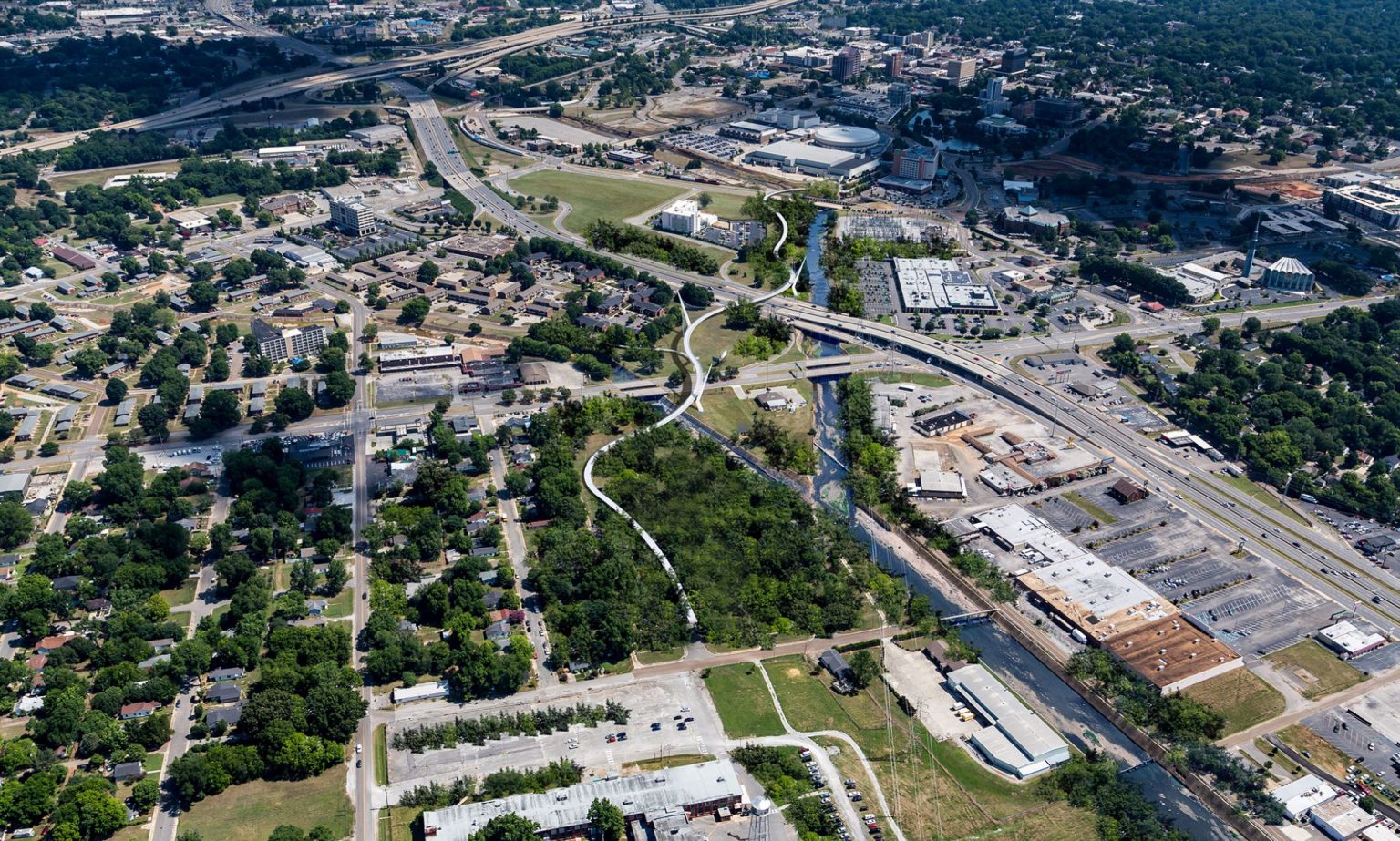
Official City of Huntsville conceptual rendering. A rendering shows design intent, not the completed structure or a guaranteed final appearance.
What the project includes
The bridge attracts almost all the attention because it is the most visible piece. The City's current project descriptions identify a broader package:
Two connected highway crossings
The cable-supported pedestrian and bicycle bridge crosses Governors Drive and Memorial Parkway, with a landing between them near the Mill Creek and Constellation areas. Although it is commonly discussed as one “Skybridge,” it is effectively two connected spans.
Pinhook Creek flood work
About 5,600 feet of channel excavation, including 3,200 feet of low-flow channel. The first construction contract includes roughly 100,000 cubic yards of excavation and 90,000 square feet of retaining wall.
Linear park and greenway
The 2024 federal scope describes 1.2 miles of linear park and 6,000 feet of greenway. An August 2024 City release used two miles for the park, illustrating why the final built quantities should be tracked against the contracts.
Three creek bridges
Three smaller precast pedestrian bridges are planned across Pinhook Creek to connect the park and greenway network.
Railroad bridge replacement
A concrete bridge is planned to replace the wooden railroad bridge beside Heart of Huntsville Drive, improving an aging freight crossing as part of the same corridor.
Where the money comes from
$20 million2022 federal RAISE award
$27.34 million2023 federal Neighborhood Access and Equity award
$5 millionState of Alabama commitment reported by the City
The two federal awards total $47,335,759. Federal award documents say the money supports the approved PARC scope: safety, reconnection of neighborhoods separated by highways and the creek, access to jobs and services, flood mitigation, and multimodal transportation.
Grant money is not interchangeable
A frequent objection is that the City should move the federal dollars to unrelated roads, sidewalks, drainage projects, or public services. The Council's October 2025 discussion clarified that the awards are tied to the project Huntsville submitted. If the City abandons the required scope, it risks returning the money; it cannot simply place those federal dollars in the general capital budget.
That does not end the value-for-money discussion. It changes the right question to: What local money is required, what obligations come with accepting the grants, and will the completed project deliver the promised public benefit?
Why the cost headlines do not match
The public has seen PARC described as a roughly $57 million, $62 million, $65 million, and later $78 million project. Those numbers come from different dates and do not always use the same scope. The records establish several individual amounts, but the City has not published one current, easy-to-follow sources-and-uses table that reconciles every phase.
Date
Documented amount
What it describes
2022
$57,377,098
USDOT's estimated total project cost when the $20 million RAISE award was announced.
2023–24
$47,335,759
The combined RAISE and Neighborhood Access and Equity federal awards—not the total project budget.
Aug. 2024
$1,928,000
Rosales + Partners suspension-bridge design agreement, including permitting, testing, specifications, and required review.
Nov. 2025
$31,017,400
MPO programmed estimate for the Pinhook Creek channel-improvement component, increased from an earlier $18 million estimate.
Feb. 2026
$20,092,195.14
Actual first-phase construction award to Lambert Contracting for 3,200 feet of Pinhook Creek work.
Feb. 2026
$69,450
Design agreement for foundations and abutments for the three smaller creek bridges.
These amounts should not be added together without checking for overlap. For example, design and component estimates may sit inside a larger program total.
The honest conclusion is not that every published figure is wrong. It is that residents still need a current phase-by-phase budget showing grants, State funds, local funds, design, right-of-way, utilities, construction, contingency, and future maintenance in one place.
Where the project stands
Early 2000s
Flood work begins as the core idea
The effort originated around Pinhook Creek flood mitigation and later expanded into a multimodal corridor.
2022
Huntsville wins the RAISE award
USDOT awards $20 million toward an estimated $57.38 million project.
2023–24
A second federal award fills more of the gap
The Neighborhood Access and Equity award adds $27.34 million. Huntsville and ALDOT execute a funding agreement for both awards.
2024
Final engineering contracts move ahead
The Council approves suspension-bridge and channel-design work.
2026
Construction begins with Pinhook Creek
The $20.09 million first-phase contract covers channel widening and restoration from Holmes Avenue to Memorial Parkway. The large bridge is not yet the active construction phase.
Next
Later bids will determine much of the final picture
The bridge, railroad crossing, smaller creek bridges, landscaping, lighting, park features, and other later work still require public contract and schedule tracking.
Public schedules have moved. A 2025 grant discussion cited December 2028, while an April 2026 project update reported an end-of-2029 target. Until the City publishes a current master schedule tied to each contract, the safest description is that completion is planned for the later part of this decade.
The safety and access case
The federal awards were not based on appearance alone. USDOT documents emphasize that highways and Pinhook Creek separate nearby disadvantaged neighborhoods from downtown jobs, healthcare, education, public services, and recreation.
The City reports 46 pedestrian deaths in the project area since 1988—37% of Huntsville's total. It also cited six deaths and 24 serious injuries from 2018 through 2022 when discussing the grant. Those are consequential claims, but the underlying crash-level dataset was not included in the records reviewed for this page. The figures are therefore attributed to the City rather than presented as an independently reproduced calculation.
A bridge can remove a dangerous crossing only if people can reach it conveniently and the route works for wheelchairs, bicycles, strollers, and everyday trips. The practical measures should include ramp grade, travel distance, shade, lighting, emergency access, maintenance, connections at both ends, and actual usage after opening.
What public sentiment appears to be
Local news coverage, Council comments, and public Huntsville discussion forums show persistent disagreement. This is a qualitative review of self-selected comments, not a scientific poll and not proof of citywide opinion.
“Make walking and biking safer.”
Supporters point to dangerous highway crossings, missing network connections, access to downtown and medical jobs, and Huntsville's broader shortage of safe non-car routes.
“That is too much for a bridge.”
Critics compare the visible structure with roads, drainage, transit, utilities, schools, and neighborhood sidewalks. The changing cost headlines deepen that concern.
“The creek and park work change the equation.”
A recurring middle position is skepticism about the signature bridge but support for flood mitigation, stream restoration, greenway, park space, and the railroad bridge replacement.
“Who benefits from redevelopment?”
Some commenters welcome investment around Mill Creek and west downtown. Others worry that nearby lower-income residents could bear disruption or displacement without sharing the long-term benefit.
“Will people actually use it?”
Usefulness depends on routes at both ends. Commenters often compare it with pedestrian crossings that feel indirect or disconnected from destinations.
“Federal money is still public money.”
Supporters note that restricted grants cannot be freely reassigned. Critics answer that grants still carry local costs, obligations, and opportunity costs that deserve scrutiny.
The District 3 angle
PARC is a citywide investment outside District 3. Residents from South Huntsville may use it, and a safer, more connected downtown can produce citywide benefits, but the records reviewed do not quantify a direct District 3 return.
The useful District 3 question is not whether every dollar must be spent inside the district. It is whether Huntsville applies the same discipline everywhere:
Publish the complete budget before the largest construction awards.
Show local dollars separately from restricted federal and State funds.
Track change orders and schedule changes by phase.
Measure safety, flood reduction, usage, accessibility, maintenance, and nearby-resident benefit after opening.
Give District 3 roads, drainage, sidewalks, greenways, parks, and public facilities an equally transparent capital plan.
A major project can be worthwhile and still require hard questions. In fact, the bigger the promise, the stronger the public reporting should be.
What the records establish—and what remains open
Established
The Skybridge is part of PARC, not a separate stand-alone project.
Two federal awards total $47,335,759.
The State committed $5 million.
The first construction contract is $20,092,195.14.
Construction began with Pinhook Creek work in 2026.
The large bridge is a later phase.
Federal funds are restricted to the approved project scope.
Still needed
A current all-in budget reconciling every published total.
Later-phase construction bids and contingencies.
One authoritative master schedule.
A long-term operations and maintenance budget.
Accessibility and route-convenience documentation.
Public performance targets for safety, flooding, use, and neighborhood benefit.
Clear safeguards so nearby residents share in redevelopment benefits.
A constructive standard
PARC should not be sold as a rendering, and it should not be dismissed as only a bridge. The public record supports real flood-control, safety, access, park, greenway, and infrastructure purposes. It also supports asking for a clearer current budget and measurable results.
Before the largest remaining construction awards, the City should publish a one-page sources-and-uses statement and maintain a public PARC scorecard covering cost, schedule, change orders, grant reimbursements, flood performance, pedestrian use, safety outcomes, accessibility, maintenance, and nearby-resident benefit.
Sentiment note: Public comments from local news coverage, City Council discussion, and public r/HuntsvilleAlabama threads from 2022–2026 were reviewed for recurring themes. They were not counted as votes, weighted demographically, or presented as a representative survey.
Have a contract, correction, or firsthand question?
Send the public record or detail you think belongs in this review. The page will be updated when new evidence clarifies the budget, schedule, or final design.