Meta's Huntsville Data Center
The public agreement gives the City firm obligations. Its investment, job, and wage figures for Meta are estimates — with no default if they are never realized.
The headline numbers are not enforceable promises
The City's announcements highlighted investment, jobs, and wages. Section 2.2 of the agreement calls those figures Company Estimates, says Meta is not obligated to achieve them, and says missing them is not a default. That distinction should have been as prominent as the numbers themselves.
What the City agreed to
These are not assumptions about the Data Center. They are terms in the 2021 Project Ferris agreement approved by the City, the Industrial Development Board, and Meta's affiliate, Velvet Tech Services, LLC.
- No enforceable floor for investment, jobs, or wages. Section 2.2 leaves development and construction to the company's sole discretion. The stated capital investment, employment level, and average compensation are estimates only. Meta is not obligated to reach them, and the agreement says it is not a default if the estimates are never realized or the project is not built as described.
- Project-related City fees waived. Section 3.3 waives every City permit fee and every other City fee related to the project's design, approval, development, or construction for the term of the agreement.
- Water and sewer priority during a shortage. Section 3.4 says public-health and safety operations come first. After that, the project receives priority for uninterrupted water and sewer service over current and future residential and recreational uses, and top priority over current and future commercial uses.
- Ordinary shortage restrictions do not apply. The same section says water or sewer consumption measures and limitations arising from a shortage do not apply to the project unless clear and critical public-health or safety conditions require them.
- City infrastructure at no cost to Meta. Section 3.4 assigns the City and Huntsville Utilities water and sewer connections, specified roadway work, and other listed infrastructure at no cost to the company. The exhibits separately assign certain water and sewer projects to Meta, so the agreement does not place every infrastructure expense on the City.
- Tax abatements and their administrative costs. Section 3.14 consents to the maximum available non-educational state, county, and City ad valorem, construction-related transaction, mortgage, and recording tax abatements for the maximum period allowed by law. It also waives fees or costs related to granting those abatements.
- Dedicated and expedited City support. Sections 3.1 and 3.2 require a full-time City employee, approved by the company, to coordinate the project at no charge to Meta. The City also agreed to expedited reviews and commercially reasonable efforts to advance completion and continued operation.
The imbalance is written into the agreement
The City's fee waivers, service priorities, infrastructure work, tax treatment, staffing, and permitting support are stated as obligations. The investment, employment, and wage figures promoted to the public are expressly nonbinding estimates. Huntsville residents are entitled to know that these are not equivalent commitments.
What the public still has not been shown
The agreement requires Huntsville Utilities to execute a separate Utility Agreement before Meta must perform its obligations. That document was not included with the published agreement, and no public copy was located in the records reviewed for this page.
- No published Meta electric-service contract showing the actual service terms.
- No published customer-specific electric rate showing what Meta pays. Huntsville Utilities' public commercial schedule stops at 5,000 kW and directs larger customers to contact the utility for specific rate information.
- No published cost-of-service study showing whether the rates recover the full cost of serving the campus and whether other utility customers bear any related costs.
- No full-buildout utility forecast for peak electric demand, annual electricity, water withdrawal, water consumption, or wastewater discharge.
Will this lower my taxes?
It can happen elsewhere. Huntsville has not shown that it happened here.
The City projected an $8.1 million return on its investment and an additional $8 million to $10 million for local schools when the second campus is complete. The reviewed public materials do not provide the assumptions, time horizon, current collections, or net calculations needed to verify those projections.
Alabama's incentive law allows qualifying data-processing centers to receive up to 30 years of non-educational property and sales-and-use tax abatements. Educational portions remain taxable. The Project Ferris agreement grants the maximum available abatements and waives related fees, so the amount promoted for schools is not the same as unrestricted revenue available to lower residents' City tax burden.
There are documented examples where data-center revenue helped lower tax rates. Virginia's legislative audit found that Loudoun and Prince William counties used data-center revenue to lower real-estate tax rates. Loudoun now says data centers generate almost half of its property-tax revenue and that its real-property tax rate fell from $1.285 per $100 of assessed value in 2008 to $0.805.
That does not establish the same result in Huntsville. Loudoun has the world's largest concentration of data centers, and a lower tax rate does not necessarily produce a lower homeowner tax bill when assessed values rise.
Bottom line: no reviewed public record shows that Meta has lowered Huntsville residents' tax rates or tax bills. To make that case, the City should publish actual annual revenue received, the value and expiration of every abatement, the public costs incurred, and the specific tax reduction residents received because of the project.
Will this raise my utility rates?
The honest answer: there is a risk, but Huntsville has not published enough information to calculate it
Meta's reported 2024 electricity use equals an average load of about 98.6 megawatts. Huntsville Utilities' public commercial rate schedule ends at 5 megawatts and directs larger customers to contact the utility for specific rates. Without Meta's electric-service contract, customer-specific rate, and cost-of-service study, residents cannot verify whether Meta fully covers the generation, transmission, substations, and other infrastructure required to serve it.
Huntsville Utilities proposed a 5.3% residential electric-rate modification, phased over 2025. The utility attributed the proposal to sharply higher material, construction, and cost-to-serve expenses. Its published explanation did not attribute the proposal to Meta, so it would be unsupported to claim that Meta caused it.
There is nevertheless a legitimate regional concern. TVA says actual and forecast electricity demand in the Tennessee Valley is increasing primarily because of population and data-center growth. New generation and transmission cost money, and rate structures determine whether those costs remain with the large customers creating the demand or are shared more broadly.
Virginia's independent legislative audit illustrates the risk, but it is not a Huntsville forecast. The audit found that data centers were paying their current cost of service, yet projected data-center growth could still add about $6 to $23 per month by 2030 and $14 to $37 per month by 2040 to generation and transmission charges for a typical Dominion residential customer using 1,000 kWh monthly.
Bottom line: the public record does not prove Meta has raised Huntsville residential rates, and it does not prove residents are protected from future costs. Publishing the utility agreement, electric rate, cost-allocation protections, and full-buildout cost study would answer the question.
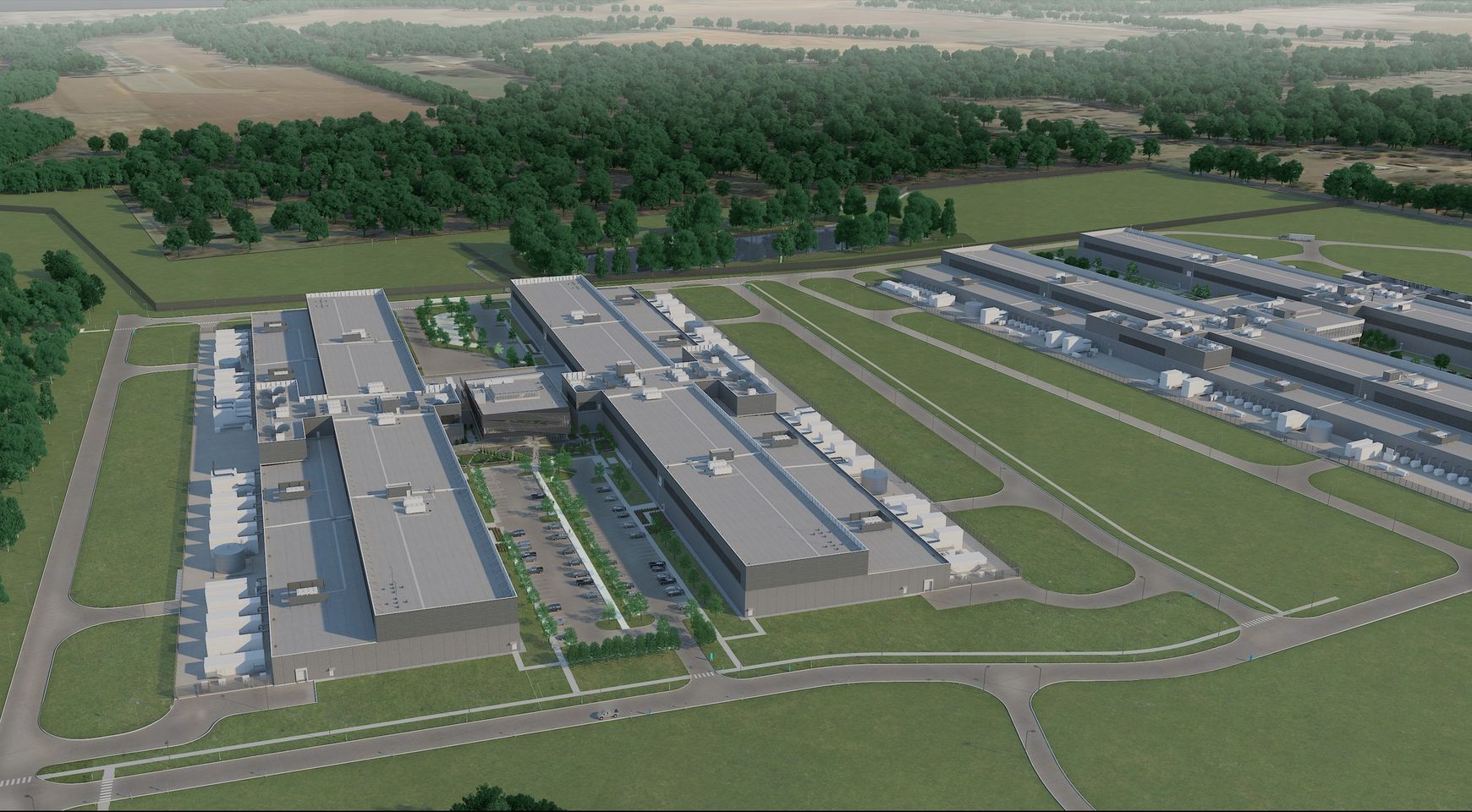
The City describes Meta's combined Huntsville campus as nearly 600 acres — roughly the land area of a large farm. That establishes the site's physical scale without treating total property acreage as a measure of water use.
Published annual electricity and water totals
Meta's 2025 Environmental Data Index reports the following full-year totals for its Huntsville site. Electricity is reported in megawatt-hours and water withdrawal in megaliters.
| Year | Annual electricity use | Annual water withdrawal |
|---|---|---|
| 2021 | 85,286 MWh | 39 ML |
| 2022 | 368,841 MWh | 104 ML |
| 2023 | 614,198 MWh | 152 ML |
| 2024 | 865,803 MWh | 209 ML |
For scale, 865,803 MWh spread evenly across 2024 equals an average load of about 98.6 megawatts. That is a calculation from annual energy use — not the facility's peak demand. The 2024 water figure is about 55.2 million gallons, or an average of roughly 151,000 gallons per day. Withdrawal is not the same as consumption or wastewater discharge.
From 2023 to 2024, the reported electricity figure increased about 41%, while reported water withdrawal increased 37.5%.
What does 55.2 million gallons a year mean?
Meta's reported 2024 water withdrawal is easier to understand when it is compared with familiar annual uses.
| Water-use comparison | Average per day | Annual total |
|---|---|---|
| Meta Huntsville Data Center — reported 2024 withdrawal | 151,000 gallons | 55.2 million gallons |
| About 460 four-person households — using EPA's average at-home rate | 150,900 gallons | 55.1 million gallons |
| Pinehurst No. 2 — an 18-hole golf course in North Carolina, before restoration | 150,700 gallons | 55.0 million gallons |
About a year of water for 460 four-person households
The EPA reports that each American uses an average of 82 gallons per day at home. At that rate, Meta Huntsville's reported 2024 withdrawal equals the combined annual at-home use of approximately 460 four-person households.
The golf-course comparison is also remarkably close: Pinehurst No. 2, an 18-hole championship course in North Carolina, previously used about 55 million gallons per year. A 2014 report said restoration work and reduced irrigated turf lowered that course's annual use to 12 million gallons.
Wastewater infrastructure: what 1,400 GPM means
The Project Ferris wastewater agreement describes a lift station with a design peak flow of 1,400 gallons per minute, approximately 16,500 feet of 12-inch force main to the Dry Creek gravity trunk near Pulaski Pike, and approximately 9,500 feet of 6-inch force main toward existing gravity sewer near Creative Way.
A capacity number is not a discharge number
If a pump moved 1,400 gallons per minute continuously, that would equal 2.016 million gallons per day. But the agreement identifies 1,400 GPM as a design peak flow for the lift station. It is not evidence that Meta currently discharges, or is projected to discharge, that volume.
An unresolved investment inconsistency
The City's 2021 announcement said the company had invested $3 billion in Huntsville “to date.” Meta's 2022 announcement and its current Huntsville information sheet say more than $1.5 billion. The reviewed materials did not explain whether the City used a different measure, combined commitments with completed spending, or made an error. This page does not choose between those figures without supporting documentation.
Read the source material
- City of Huntsville — original Data Center announcement (2018)
- Meta — “Huntsville, We're Growing!” (2022)
- City of Huntsville — Data Center expansion announcement (2021)
- Meta — Huntsville Data Center information sheet
- Meta — 2025 Environmental Data Index
- Golf Course Industry — Pinehurst No. 2 annual water-use reduction
- Pinehurst Resort — history of the 18-hole Pinehurst No. 2 course
- U.S. Environmental Protection Agency — residential water-use statistics
- City of Huntsville — Project Ferris development agreement
- Huntsville Utilities — published commercial rates
- Huntsville Utilities — 2025 electric-rate modification and stated reasons
- Tennessee Valley Authority — 2026 Integrated Resource Plan
- Virginia Joint Legislative Audit and Review Commission — Data Centers in Virginia
- Loudoun County, Virginia — data-center tax revenue and tax-rate information
- Alabama Department of Revenue — Chapter 9B abatements
- City of Huntsville — Wastewater collection and treatment
Have a source we should review?
Send a public record, document, or correction. The page will be updated when new evidence changes or clarifies the record.